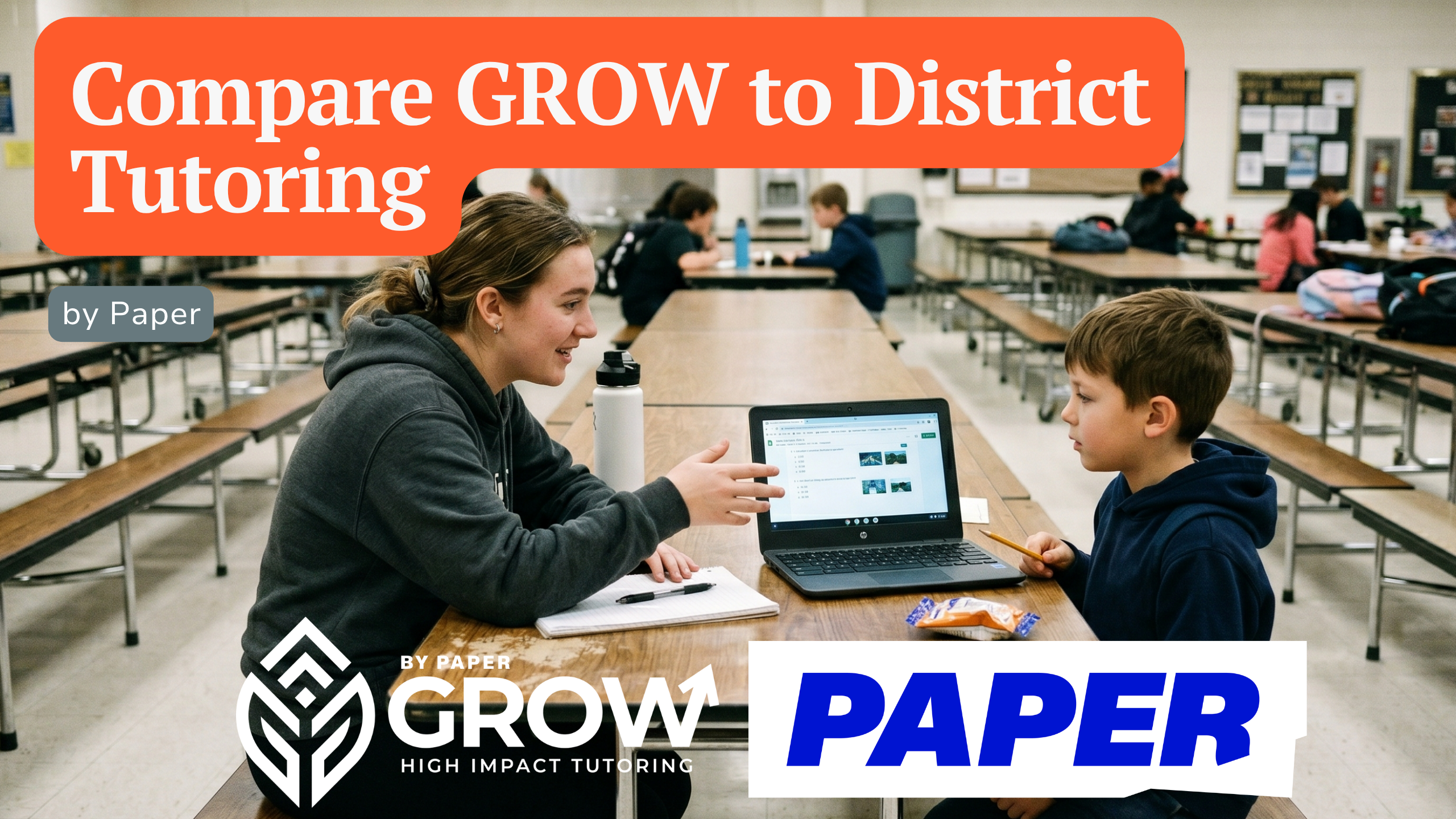

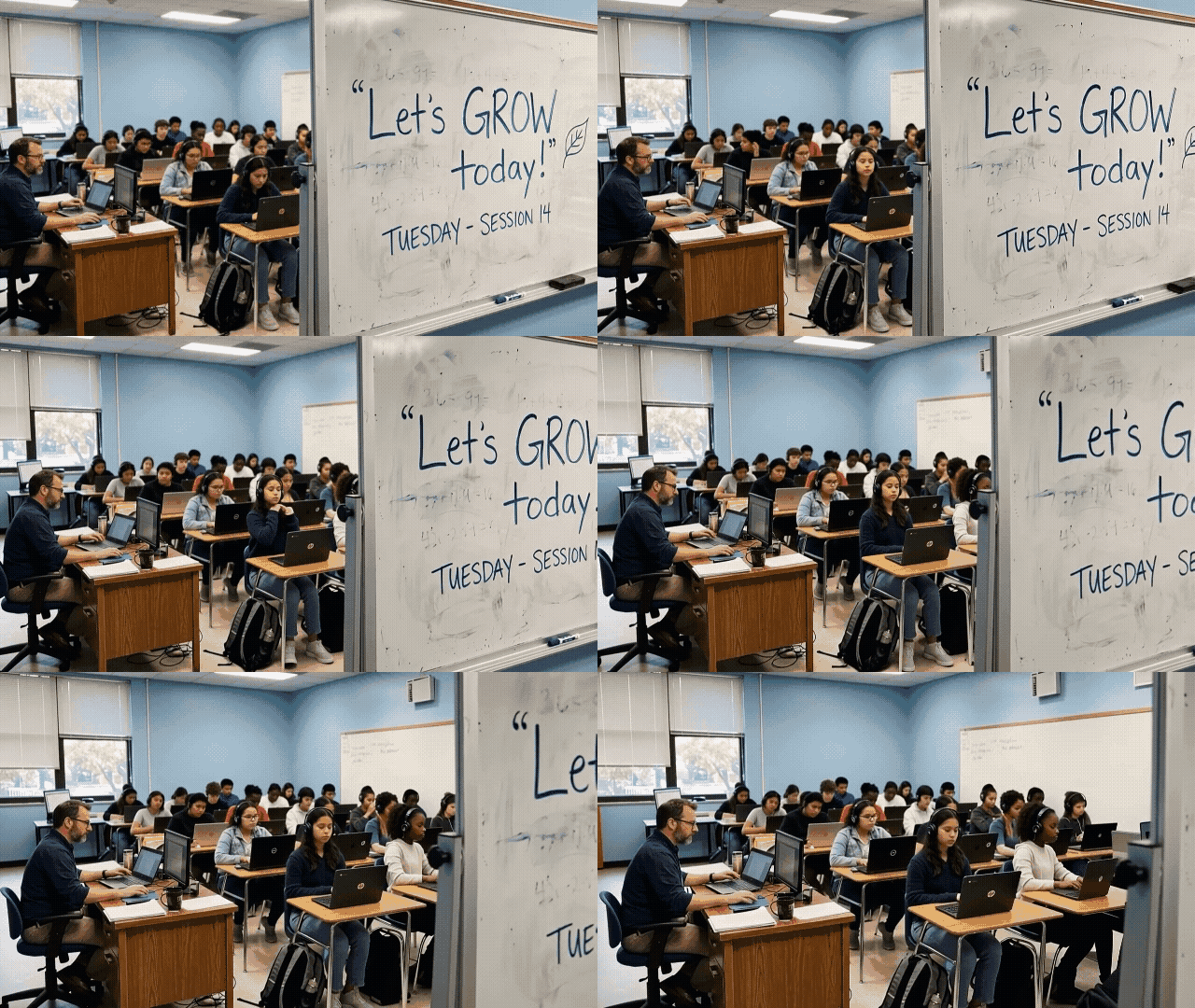

Real instructional exchange based on actual classroom learning.
At its best, high impact tutoring (HIT) reinforces classroom instruction through consistent tutors and content aligned to what students are learning in class
High Impact Tutoring (HIT) is:
- Live, virtual small-group cohort sessions
- typically delivered 3x per week, 90 minutes per week,
in 8–12 week cycles - with the same tutor each session
- using curated content aligned to district pacing
- measured by benchmark data and granular progress monitoring
- usually happening in class during the school day, but can run afters school or intersession

Where Tier 2 targeted support typically breaks down:
Instructional Continuity
Supports are not anchored to what students are actually learning in class, so instruction runs parallel to—rather than reinforcing—classroom learning.
Relational Continuity
Students rotate between adults, or the same staff are stretched too thin to stay consistent, making it hard to sustain trust, momentum, or accountability.
Even strong in-person, in-house tutoring programs get harder to maintain with consistency when expanding:

In-House Tutoring
GROW High-Impact Tutoring Preserves Continuity at Scale
Most targeted support breaks down because systems are forced to trade instructional and relational continuity for scale—GROW is intentionally designed to avoid that compromise.
What makes GROW fundamentally different from other Tier 2 programs:
TUTOR & CURRICULUM CONTINUITY
When tutors change or instruction isn’t aligned to the classroom, students don’t build momentum, they start over.
GROW uses a dedicated tutor workforce, not independent contractors. That means we can schedule and train our tutors because to Paper, HIT is not gig work.
When no one truly owns tutor scheduling, tutor session content, or student progress monitoring, consistency is the first thing to slip. And over time, consistency gives way to what’s urgent.
Paper handles the program design, before and after outcome data, tutor logistics, and curates session content based on district pacing and standards to reinforce classroom learning. We can even launch with you in person on day 1.
What matters is whether students are measurably moving forward—and how you respond when they’re not.
Evidence-Backed. Classroom-Proven. District-Defensible.
What happens when continuity stays intact and partners stay accountable.
How one district closed math gaps with GROW in 12 weeks
Visalia Unified School District paired 5th-grade math students who were 1+ grade levels behind with a trained GROW tutor in a 3:1 group setting. After a 12-week program:
- 38% of students moved up one or more grade level
- 15% of students advanced from below grade level into the expected range
- 78% of students reported feeling confident in solving math problems independently and tackling new topics

How GROW helped 4th graders boost ELA proficiency by 350%
Prairie Hills Elementary School District 144 tapped the GROW program to provide targeted ELA support for 4th and 5th graders who had fallen behind. After a 12-week session:
- 350% increase in grade-level proficiency among 4th graders
- 130% increase in students at/near grade level among 5th graders
- 84% of students reported feeling prepared for new topics
Academic Impact, Earned and Independently Validated
.png?width=250&height=91&name=Untitled%20design%20(2).png)
3 times as many students are proficient in ELA
and/or math after 12 weeks of GROW
35% average score lift in nationally normed
benchmark assessments

One of the only programs with ESSA evidence
specific to high impact tutoring outcomes

Program design validated by Stanford's National
Student Support Accelerator (NSSA)