Michigan Funds Tutoring That Works. GROW Is Already Approved to Deliver It.
If you have students below proficiency, you likely already qualify. GROW is already on the state's vetted list, so you can turn that funding into high-impact tutoring now.
.png?width=1920&height=1080&name=Hero%20Graphic%20(5).png)
Get the Michigan 23g playbook (HIT plan template included)
Section 23g asks your district to describe its tutoring in a MICIP plan. This is a standards-aligned high-impact tutoring plan, built to drop straight into your submission. Grab the template, adapt it, submit.
What's in the plan:
- A ready-to-adapt tutoring strategy and activities, written to meet Michigan's 23g eligibility criteria
- Bracketed fields for the pieces you own, your goal, data story, and student cohorts, with GROW's tutoring language pre-filled
- The dosage and structure the state looks for: three 30-minute sessions a week, small groups up to four, the same tutor all program long
- The named strategy expert requirement handled, with training, coaching, data reviews every 4 to 8 weeks, and fidelity checks
- A progress monitoring plan with baseline, formative, and end-of-program assessments that feed your MiDataHub reporting
What It Funds
The grant pays for tutoring and academic support, including:
- Tutoring and expanded learning time
- Tier 2 academic help during, before, or after school, or in summer
- Programs judged on student growth, not just sign-ups
Who Qualifies
It's formula funding, so most districts with students below proficiency already qualify:
- Districts and ISDs (an ISD can apply for its districts)
- Based on students below proficiency on the state test
- Reading, math, or both
How You Get It
Two steps:
- Get eligible: submit a short plan from your MICIP report
- Get funded: the state sets your amount, you submit a budget
- Spend only on state-vetted programs, like GROW
Compare Before You Commit
Every provider on the approved list will call it high-dosage tutoring. These are the differences that decide whether students build momentum or simply log time.
| GROW BY PAPER | THE "ANY-TUTOR-ANY-TIME" VENDORS | THE "ALL-IN-ONE" BIG BOX VENDORS | DIY IN-HOUSE TUOTRING | |
|---|---|---|---|---|
| Same trained tutor every session |
Yes, all cycle | Rotating, any-tutor-anytime | No consistent human tutor | Spotty coverage, you have to hire and/or schedule |
| Tutor employment model | U.S.-based W-2 workforce | Independent contractors, sometimes not U.S. -based | Software first, staffing varies | Independent contractors or teachers with extra time |
| Aligned to your pacing and standards |
Built to your curriculum | Generic or tutor-dependent | Fixed proprietary content | Aligned, bu you have to create and manage programs |
| Scheduling, rostering, and launch |
Fully managed by Paper | Left to your team | Mostly self-serve | Left to your team |
| ESSA evidence for the tutoring program itself |
ESSA Level III for HIT | Often borrowed from another product | Evidence tied to software, not HIT | Not applicable, progress monitoring is hit and miss |
| What it actually does |
Tutoring is the whole business | Consumer tutoring marketplace/tutoring as gig work | Tutoring is one product of many | Logistical management outweighs tutoring impact |

Continuity is the real difference
High-dosage tutoring works because of two things nearly every shortcut gives away. Protect both and students build. Break either and you are back to activity that looks busy and moves nothing.
TUTOR & CURRICULUM CONTINUITY
When tutors change or instruction isn’t aligned to the classroom, students don’t build momentum, they start over.
Progress only happens when learning compounds, not resets.
When no one truly owns tutor scheduling, tutor session content, or student progress monitoring, consistency is the first thing to slip.
And over time, consistency gives way to what’s urgent.
What matters is whether students are measurably moving forward—and how you respond when they’re not.
Data that shows growth, not just usage
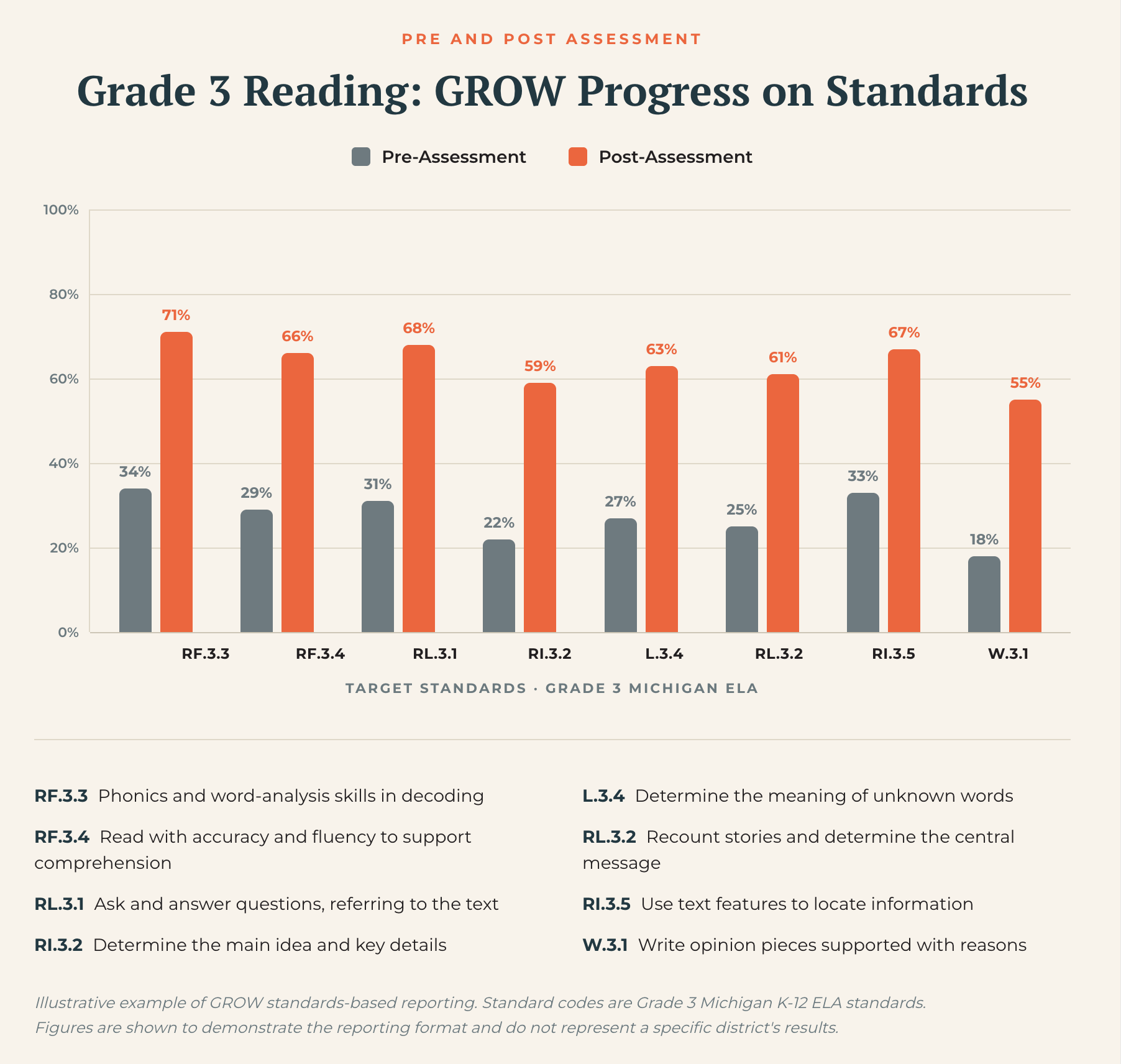
Michigan runs on evidence, and so does GROW. Every student starts with a baseline, gets formative checks in every session, and finishes with an end-of-program assessment, all mapped to standards. You see growth as it happens, and Paper validates it against the measures you already trust.

Before and after, at the standard level
Baseline, formative, and end-of-program assessments show exactly which standards students mastered.
Validated against your benchmarks
Results are checked against the measures your schools use, including i-Ready, NWEA MAP, and Michigan's M-STEP.
Fidelity and outcomes, tracked apart
Paper reports whether the program ran with fidelity and whether students grew, so the story is never blurred.
Michigan's own 23g evaluation found high-impact tutoring produced the strongest early-grade reading gains of any funded program type.
.png?width=250&height=250&name=Homepage%20Graphics%20(30).png)
Validated for High-Dosage Tutoring. Ask the Others to Prove the Same.
3× academic growth at uncompromised scale — embedded, enduring, and accountable. ESSA level III evidence. NSSA program design certified.
Paper is a tutoring company. Not an education company adding tutoring on the side.
Since 2014, one focus: designing, delivering, and managing high-dosage tutoring. When tutoring is the whole business, it gets the whole company behind it. That shows up in the tutors, the training, the program design, and the results.
500+
Districts Partnered
4M+
Students Supported
2014
Single Focus on Tutoring Since
Your Young Learners. Your Tier 2 Students. Your EL Population.
GROW Moves Them All.
Prairie Hills Elementary School District (IL) | 4th/5th Grade ELA
Following the students in the 2023-24 school year without GROW support, then comparing their results in 2024-25 school year after a year of GROW intervention, 3.3x more students achieved grade-level proficiency.
- + 350% Grade-level proficiency for 4th grade readers
- + 130% Students at/near grade level for 5th grade readers


Bremen High School District (IL) | 9th/10th Grade Math
The district’s goal was clear: strengthen core algebra skills and move significantly more students into proficiency within a single semester.
- Average assessment scores increased by 16 points in just 8 weeks.
- The percentage of students meeting proficiency nearly tripled, rising from 23% to 67%.